
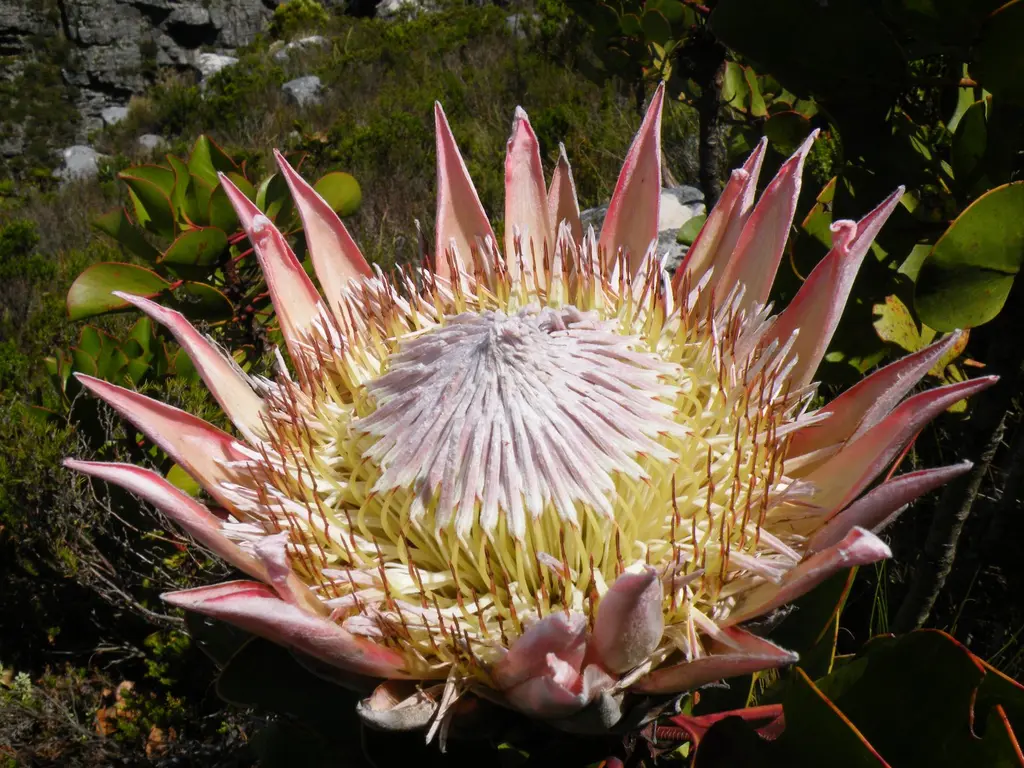
Here is a small heartbreak. Somewhere in Tuscany this weekend, a bride is paying a small fortune to have king proteas flown in for her bouquet. And somewhere in Somerset West, a South African bride is ordering imported roses.
We think about this more than is strictly healthy. The protea is our national flower, it grows on the mountain behind the venue, it is on the passport — and it is genuinely one of the most sought-after wedding flowers in the world right now. Half the boards we save from are couples in Texas and Surrey trying to recreate a fynbos bouquet from imported stems.
So this is our case for the bouquet that could only come from here: what to ask for by name, what it actually costs, and the one care instruction that decides whether your flowers look magnificent or slightly funereal by the time the speeches start.
Why the timing works in your favour
Roses have a season, and the South African wedding calendar has a habit of falling outside it. Ask any florist what an imported rose costs in the middle of winter and watch their face.
Proteas do not behave that way. The South African National Biodiversity Institute lists the king protea’s flowering season as sporadic, more or less all year — which is why a local florist can usually get you proteas in months when roses have gone silly. That is not a small planning advantage. It is the difference between a bouquet that fits your budget and one that eats the décor allowance.
For an anchor: a bunch of six proteas with fynbos, no vase, sits at R350 from a Pretoria grower (checked August 2026). Bouquet work, wiring and a florist’s time are extra, and prices move — but it tells you the raw material is not the expensive part of this look.
The cast list, so you can ask for things by name
“Something with proteas” will get you a fine bouquet. Naming the stems will get you the one on your mood board. The usual suspects:
- King protea (Protea cynaroides) — the enormous one. This is the hero and you need exactly one, possibly two. Three king proteas is not a bouquet, it is a shrub you are carrying down an aisle.
- Pink Ice (Protea compacta hybrid) — smaller, tidier, endlessly useful. The workhorse of most protea arrangements and the one that photographs softly rather than dramatically.
- Blushing bride (Serruria florida) — delicate, cream-and-pink, and named for exactly this job. We have written about this one before because it is impossible not to.
- Pincushions (Leucospermum) — the orange and coral fireworks. One or two lifts an entire arrangement out of beige.
- Leucadendron — the silver and burgundy foliage doing the quiet structural work. Ask for it by name or you will get generic greenery.
- Restios — the tall reedy grasses that stop an arrangement looking like a florist’s idea of the veld.
- Brunia — small silver-grey balls, uncannily good in photographs.
If you want to go further into indigenous territory, the strelitzia sits happily alongside all of the above for a bolder, more tropical read.
Building it, without the usual mistakes
- One hero, three supporters. A single king protea, a few Pink Ice, pincushions for colour, leucadendron and restio for shape. Bouquets that give every stem equal billing turn to mush at two metres, which is the distance every guest will actually see it from.
- Ask what it weighs before you commit. A generous king protea bouquet is a properly substantial object, and you are holding it one-handed, in the sun, through a ceremony and a receiving line. Ask your florist to let you hold something of the finished weight at the consultation rather than discovering it on the morning.
- Insist on wired stems for the big heads. King proteas are top-heavy and will droop out of an unwired hand-tie by the time the photographs start.
- Ask about shape if you are marrying somewhere windy. A big round hand-tie catches a Cape south-easter in a way a flatter, more structured shape does not. Your florist will have an opinion the moment you say where the ceremony is.
The care instruction that actually matters
Protea foliage has one notorious habit: the leaves turn black. It is called leaf blackening, it is the single most common complaint about proteas as cut flowers, and it can show up within days.
The leading explanation is that the leaves run short of stored carbohydrate once the stem is cut, and blackening follows. Researchers hedge that more carefully than a wedding blog needs to — the picture involves cutting off photosynthesis and what that does to the leaf’s chemistry — but the practical upshot is agreed on, and it means the problem is largely preventable:
- Put sugar in the water, not just flower food. Trials on ‘Sylvia’ proteas found glucose in the vase water took vase life from about six days to about twenty. Ordinary table sugar is sucrose, not glucose, and in the same research it did not help and sometimes made blackening worse — so ask your florist for a glucose-based holding solution rather than improvising with the sugar bowl.
- Keep them light and cold — not one or the other. Two days in a dark storeroom burns through the carbohydrate that keeps the leaves green, and good light measurably slows blackening. But cold slows it independently too, so a well-lit cold room beats either on its own.
- Take delivery as late as you sensibly can. Every day between the farm and the aisle is a day of that clock running.
Say the words “leaf blackening” to your florist at the first meeting. A good one will be delighted you asked; it tells them you will not be phoning on the Monday asking why the leaves went dark.
Where else to put them
- One stem, one bud vase, down the length of the table. The cheapest good-looking centrepiece there is, and proteas are big enough to carry it alone.
- A single Pink Ice on the cake. Ask for it unwired and food-safe, placed on the day.
- Boutonnières of brunia and leucadendron. They survive a full day of hugging, which roses emphatically do not.
- Dry the bouquet afterwards. Proteas dry better than almost anything — hang them upside down somewhere dark and dry and you keep the bouquet, not a photograph of it.
One last thing
Book your florist before you finalise your palette, not after. Fynbos comes in a specific set of colours — dusty pinks, rust, cream, silver-green, burgundy — and they are beautiful together because they grow together. Choose the palette first and you end up paying for dyed or imported stems to fill the gaps, which rather defeats the point.
If you love a protea, let the protea pick the palette. It has had a few million years of practice.
Protea bouquet questions, answered
What should a protea wedding bouquet cost? Ask for the stems and the design to be quoted separately, because the stems are where proteas help you: six proteas with fynbos ran R350 from one Pretoria grower in August 2026, with wiring and design on top. They generally compare well against roses out of rose season — but get both priced for your actual week.
Will proteas survive an outdoor summer ceremony? Better than most. They are built for hot, dry, windy mountainsides, which is a fair description of a lot of South African wedding venues in January. Keep the bouquet out of direct sun before the ceremony and it will be fine.
Why did my protea leaves turn black? Almost certainly nothing you did wrong — it is a well-known post-harvest habit of the plant, and the usual explanation is the leaves running short of stored carbohydrate once cut. Glucose in the holding water helps, as do bright and cold conditions together; long dark storage makes it worse.
Can I use proteas for a winter wedding? Yes — this is one of their real advantages. The king protea flowers sporadically through the year rather than in a single narrow window, so a winter date does not automatically push you towards imported flowers. Confirm what your florist can actually source for your specific week, since individual varieties do come and go.
Save this one for your florist meeting. We are building out our fynbos and indigenous flower boards over on Pinterest — come and follow along if you are putting a South African bouquet together.