
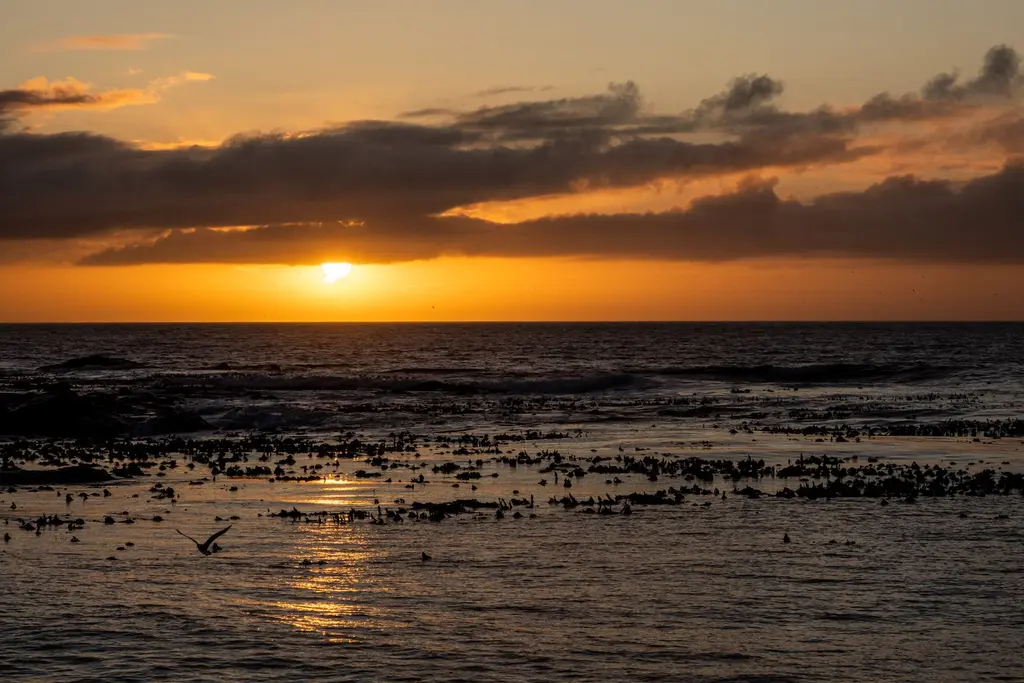
There is a photograph you have definitely saved. The couple is small in the frame, the sky behind them has gone a deep electric blue, and there is a warm light on them from somewhere. It does not look like a wedding photograph. It looks like a film still.
That is blue hour, and we are watching it take over wedding boards at a fairly startling rate. Here is the thing nobody mentions in the caption: it lasts about twenty-five minutes, it happens after sunset, and in most wedding timelines those twenty-five minutes are scheduled directly on top of the starter.
So this is how to actually plan your blue hour wedding photos — which turns out to be almost entirely a question of arithmetic rather than talent, and which works out completely differently depending on whether you are marrying in Cape Town or Johannesburg.
Two different hours, and only one of them is famous
- Golden hour is the last hour or so before sunset. Warm, low, flattering light, long shadows, everybody looks wonderful. This is the one your photographer will already have planned for.
- Blue hour is the window between sunset and full dark, when the sky holds a deep saturated blue rather than going black. In South Africa that is roughly twenty-five minutes — not an hour, whatever the name suggests. To photograph a couple in it you need a light on them — a video light, a flash, the venue’s festoon lighting, car headlights at a push — because the sky is now brighter than they are.
Golden hour is a gift you can drift into. Blue hour has to be diarised, because if you look up and notice it, it is already half over.
The arithmetic, for a South African wedding
This is where imported advice falls apart, and it is worth doing properly. Approximate midsummer figures:
- Cape Town — sunset moves from about 19:45 in early December to almost exactly 20:00 by the summer solstice, and stays near there through mid-January. The sky then holds its colour until roughly 20:25. So golden hour is about 19:00 to 20:00, and blue hour runs from sunset to about 20:25.
- Johannesburg — sunset is about 18:50 in early December and about 19:05 by mid-January, with the sky holding until roughly 19:30. Golden hour is therefore about 18:00 to 19:00, and blue hour is finished before half past seven.
That is the better part of an hour’s difference between two venues in the same country in the same week, and it is the single most common reason a couple never gets the shot. A Highveld reception that seats guests at seven has already missed it. A Cape Town reception that seats at seven is sitting down an hour before the good part.
Note that these shift by a few minutes every week, and that early December and mid-January are about fifteen minutes apart at the Cape. Which brings us to the only instruction in this section that really matters.
Two practical consequences:
- Find your actual sunset time for your actual date and write it at the top of the running order. Not the month — the date. It moves by a few minutes a week.
- Then work backwards. Golden hour portraits start an hour before that number. Blue hour starts at it. Everything else in the timeline bends around those two facts.
How to buy yourself the twenty-five minutes
You do not need a long break. You need a short, well-placed one, and the trick is to steal it from something that will not miss it. Our running order guide is a good place to see where the slack actually lives.
- Slip out between courses, not between speeches. Ten minutes between the starter and the main is invisible to your guests. Ten minutes in the middle of the speeches is not.
- Tell your MC the exact time, in advance, in writing. “We are leaving the room at 20:00 and back by 20:20.” An MC who finds out on the night will fill your window with an announcement.
- Choose the spot in daylight. Walk it with your photographer at the walkthrough. In the dark, with a drink in you and fifteen minutes on the clock, is not when to be scouting a background.
- Do not change clothes, do not redo anything. The whole thing works because it is brief.
What to actually ask your photographer for
Say the words at the consultation, not on the day. Most photographers are delighted — these are the frames that end up on their own portfolios — but the ones who shoot only with available light will tell you honestly that they do not work this way, and you want to know that in advance rather than at 20:05. Our list of questions to ask your photographer covers the rest of that conversation.
- “Do you shoot blue hour, and do you bring a light for it?” The second half of that question is the one that matters.
- “Can we do a wide one where we are small in the frame?” The landscape-first shot — mountain, vines, sea, koppie — with the two of you tiny. This is the frame that gets saved, and it is the one most likely to get skipped in favour of safer close-ups.
- “What happens if the light is flat?” An overcast evening kills the colour. A good answer involves the venue’s lighting, or a plan B indoors, and not a shrug.
- “Can we see a full blue hour set, not one hero image?” Anyone can land one. You want to see a photographer who reliably gets several.
If you want to carry the idea on into the evening proper, our night photography ideas pick up where blue hour stops.
One last thing
Have a wet-weather version of this. Heavy cloud takes blue hour away entirely, and the good news is mostly on your side: Highveld summer storms tend to peak between three and six in the afternoon and clear by sunset, so more often than not the storm has passed through before your window opens. More often than not is not always.
What it gives back, if your photographer is up for it, is the storm itself — and a towering Highveld thundercloud lit from underneath at sunset is a considerably more dramatic photograph than the one you had planned. Decide in advance that you will go outside anyway. The couples who get the extraordinary weather photographs are the ones who agreed to it before the weather happened.
Blue hour photo questions, answered
How long does blue hour last in South Africa? Roughly twenty-five minutes after sunset — about twenty-seven at the Cape in midsummer, about twenty-five on the Highveld, and shorter the closer you get to the equator. Treat twenty-five minutes as your working number and you will not be caught out.
Do we need to leave our own reception? For about fifteen minutes, yes. Nobody will notice if you go between courses, and it is the only way to be outdoors at the one moment that cannot be rescheduled.
Is golden hour or blue hour better? They do different jobs. Golden hour is warm, flattering and safe, and it is where your favourite portrait of the two of you will probably come from. Blue hour is cooler, more cinematic and more dramatic. If you have to pick one, pick golden hour — then steal ten more minutes for blue.
What if our ceremony is in winter? Easier, not harder. The sun sets a great deal earlier, so blue hour tends to land during drinks rather than during dinner — you can walk out, shoot it and walk back in without touching the running order at all. Look up the sunset time for your date and you will probably find the window is already free.
Save this for your photographer meeting. We pin the light we would want on our own wedding day over on Pinterest — come and follow along.